
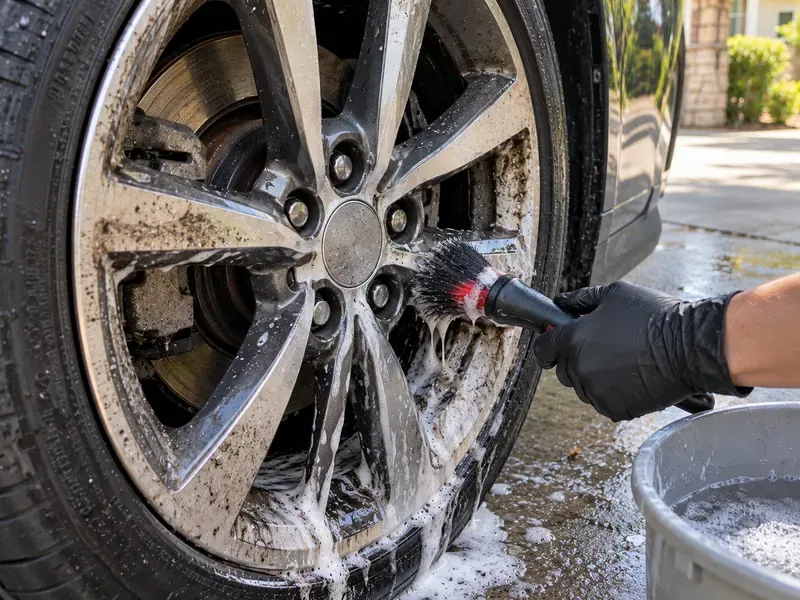
How to Remove Brake Dust From Rims Without Damaging the Finish
Every time you brake, your pads and rotors wear down a little, and that wear has to go somewhere. Most of it lands on your wheels as the gray-black film you notice on the front rims first. If your week includes stop-and-go traffic on I-35, I-44 or the Lake Hefner Parkway, it builds up fast.
Learning how to remove brake dust from rims without scratching or dulling them comes down to three things: cleaning when the wheel is cool, using a cleaner that suits the finish, and dealing with the iron particles that ordinary soap leaves behind.
Rinse the wheel while it is cool, spray on a pH-balanced wheel cleaner, and work it in with soft brushes on the face, the barrel and the lug holes. Rinse, then use an iron remover on anything left behind, and dry with a clean microfiber towel. If dust is still stuck after an iron remover and the surface feels rough, the finish may be etched, and cleaning alone will not fix that.
Why brake dust is harder to clean than road dirt
Brake dust is a mix of pad material, carbon and fine metal shavings from the rotors. Those iron particles are hot when they hit the wheel, which helps them grip the surface, and with moisture they start to rust into small orange specks. Left long enough, they can eat into the clear coat and leave a stain no cleaner will lift.
Front wheels get the worst of it because the front brakes do most of the stopping, and many European performance cars are known for especially dusty pads.
A step-by-step cleaning routine
1. Start with cool wheels, in the shade
Wheel cleaner sprayed on a hot wheel can dry before you rinse it and leave spots behind. After a drive, or a summer afternoon in an Oklahoma parking lot, give the wheels time to cool. Early morning or a shaded driveway works best.
2. Rinse off the loose layer
A thorough rinse carries away loose dust so you are not grinding it into the finish with a brush. Include the inner barrel and the area behind the spokes.
3. Use a cleaner that suits your finish
A pH-balanced wheel cleaner is the safe starting point for nearly every finish. Strong acid-based cleaners cut through heavy buildup, but they can damage clear coat, polished aluminum and chrome when used wrong or left on too long. Unless you know exactly what finish is on your wheels, leave acid cleaners on the shelf, and skip household hacks like oven cleaner or bleach, which can stain or strip a finish.
4. Work it in with the right brushes
Use a soft-bristle brush for the face, a long barrel brush for the inside of the wheel and a small detail brush for the lug nut holes. Keep these separate from your paint wash mitt, because brake dust is abrasive and scratches whatever it touches next.
5. Rinse, then treat what is left with an iron remover
Small dark or orange specks that survive the first pass are embedded iron, and they are the main reason people struggle to get brake dust off rims with soap alone. An iron remover dissolves those particles chemically instead of relying on scrubbing, and many change color as they react. Follow the label for dwell time, then rinse thoroughly.
6. Dry and check the surface
Dry with a microfiber towel kept just for wheels, then run your fingertips across the wheel face. Rough or bumpy spots after an iron remover point to stubborn contamination or damage to the finish itself, covered below.
Matching the cleaner to your wheel finish
Wheel finish | Generally safe | Use caution with |
|---|---|---|
Painted and clear-coated (most factory wheels) | pH-balanced cleaner, iron remover, soft brushes | Strong acid cleaners, abrasive pads |
Powder coated | pH-balanced cleaner, soft brushes | Abrasive pads and harsh solvents |
Polished aluminum with no clear coat | pH-balanced cleaner, aluminum-safe metal polish | Acid and strong alkaline cleaners, which can stain bare metal |
Chrome | pH-balanced cleaner, soft brushes | Acid cleaners and abrasive pads, which can haze or pit chrome |
Machined or diamond-cut | pH-balanced cleaner, soft brushes | Acid cleaners, since a thin clear coat sits over bare metal |
Ceramic coated | pH-balanced cleaner, gentle wash | Strong degreasers and abrasive tools, which wear the coating sooner |
If you are not sure which finish you have, treat the wheel as the most delicate option on the list, or check with the dealer or a wheel shop before trying anything stronger.
Most brake dust is a cleaning job, not a repair job
Forum threads on this topic often come from drivers who used an iron remover, scrubbed with a dedicated wheel cleaner, and still have a wheel that feels bumpy to the touch. When that happens, more product is usually not the answer.
Brake dust that sits for months, especially through wet weather or the salt and brine used on Oklahoma roads in winter, can etch into the clear coat or pit bare metal. At that point the stain is part of the finish, and the fix is refinishing rather than scrubbing harder. Regular cleaning keeps most wheels from ever getting there.
Signs the finish itself may be damaged
Dark or orange spots that stay put after an iron remover
A rough, bumpy feel on the wheel face after a full clean
Cloudy or dull patches that look different from the rest of the wheel
Clear coat that is flaking or peeling, often near the spokes or the lip
Small pits or white, chalky corrosion on bare or machined areas
If you see these, the wheel needs its finish repaired rather than another round of cleaning. Previously painted or damaged wheels can be stripped and refinished, and powder coating the wheels is one way to give them a fresh, durable finish.
How to keep brake dust from building up
Clean wheels every time you wash the car. Fresh dust rinses off far more easily than dust that has sat through a few weeks of heat and rain.
Use an iron remover now and then. It catches the embedded particles that regular washing misses before they have a chance to rust.
Protect the finish. A wheel sealant or a ceramic coating gives brake dust less to grab onto, so it rinses off more easily. A coating does not stop brake dust from forming. It makes cleanup quicker.
Ask about your brake pads. Ceramic brake pads often produce less visible dust than semi-metallic pads, but pad choice affects braking too, so talk it through with your mechanic.
Do not forget the calipers. Dust settles on the calipers too. If yours have custom painted brake calipers, the same gentle cleaner and soft brush work there.
For a broader routine covering curbs, potholes and inspections, see our rim maintenance tips.
What to ask before you book wheel work
Will you tell me whether a proper clean could solve this before quoting a repair?
What finish is on my wheels, and can it be matched?
Do you refinish the inner barrel, or just the face?
What protection goes on afterward, and how should I wash it?
Frequently asked questions
Will WD-40 remove brake dust from rims?
WD-40 is a lubricant and water displacer, not a wheel cleaner. It may loosen some grime, but it leaves an oily film that attracts more dust and has to be washed off anyway. A pH-balanced wheel cleaner followed by an iron remover does the job without the residue.
Will Dawn dish soap remove brake dust?
Dish soap will lift light, fresh brake dust from a sealed wheel. It is a strong degreaser, though, so it can also strip wax or sealant you have applied. It does not dissolve the embedded iron particles that cause stubborn specks, so most wheels still need an iron remover afterward.
What is the best wheel cleaner for removing stubborn brake dust?
The right cleaner depends on your wheel's finish. A pH-balanced wheel cleaner is safe on nearly every finish and handles most buildup. For specks that remain, add an iron remover. Strong acid cleaners work fast but can damage clear coat, chrome and polished aluminum, so they are best left to professionals.
What iron remover can I use to remove brake dust?
Look for a product labeled as an iron remover or fallout remover that states it is safe for your wheel finish. Spray it on a cool, rinsed wheel, let it work for the time on the label, then rinse thoroughly. Many of these products change color as they react with iron.
Brake dust that will not come off?
If your wheels still look stained after a proper clean, bring them by our shop at 800 W Hefner Rd in Oklahoma City and we will take a look. We serve drivers across Oklahoma City, Edmond, Yukon, Moore, Norman, Midwest City, Mustang and Guthrie. You can also ask us about ceramic coating, since a protected finish makes removing brake dust from rims a quicker rinse-and-wipe job.
Call (405) 313-9686 or send us a message. We are open Monday to Friday, 9 AM to 5 PM.